E-Mail:kb@czgraphite.com
Tel:+86 15533739372


Graphite news is mainly for industry users to share graphite materials and products and other related technical information, so that customers can keep abreast of industry trends and developments.
Time: 2026-07-13 02:36:50 Source: Cangzhou Carbon Technology Co., Ltd.
Every foundry or metalcasting facility knows the frustration of a cracked crucible: production stops, a pricey replacement is needed, and the risk of contamination rises. The root cause is often thermal shock — the rapid temperature changes that typical crucibles cannot withstand. This article explains how thermal shock resistant crucibles, particularly those manufactured by Cangzhou Carbon, address this failure point and deliver measurable cost savings. By understanding the mechanism and long-term value, you can make an informed procurement decision that protects your bottom line.
Thermal shock resistance is the ability of a material to resist cracking under sudden temperature gradients. In crucibles, this property is critical when they are repeatedly heated and cooled during melting, holding, or pouring cycles. Standard clay-graphite or silicon carbide crucibles may develop micro-cracks after only a few cycles, especially if they are preheated unevenly. In contrast, thermal shock resistant grades incorporate optimized grain size distribution, higher carbon content, and advanced bonding systems that allow the material to absorb thermal stresses without failure. Cangzhou Carbon’s crucibles use a proprietary formula that maintains structural integrity even when exposed to direct flame on one side and cold metal on the other.
Many operators underestimate the true financial impact of a cracked crucible. Beyond the immediate replacement cost, several indirect expenses accumulate:
These factors often make the total cost of a standard crucible 2–3 times higher than its purchase price over a year of operation.
Choosing a thermal shock resistant crucible from Cangzhou Carbon directly addresses each cost driver. Here is a breakdown of the comparative advantages:
While a conventional crucible may last 30–60 heats before cracking, a properly selected thermal shock resistant grade can easily exceed 120 heats in the same application. Fewer replacements mean lower consumables costs and reduced labor for crucible changeouts.
Because thermal shock resistant crucibles survive rapid heating and cooling without failure, operators can maintain consistent production schedules. One foundry reported that switching to Cangzhou Carbon’s crucibles eliminated emergency stoppages related to crucible cracks, saving over 80 hours of lost production annually.
These crucibles typically have a denser, more uniformly conductive wall. Heat transfers more efficiently from the furnace to the charge, reducing energy consumption by 5–10% compared to cracked or degraded crucibles. Over time, this adds up to significant energy savings.
With no cracks, the melt stays clean. Cangzhou Carbon’s crucibles resist slag penetration and oxidation, lowering the rejection rate for castings. This directly improves your yield and reduces remelt expenses.
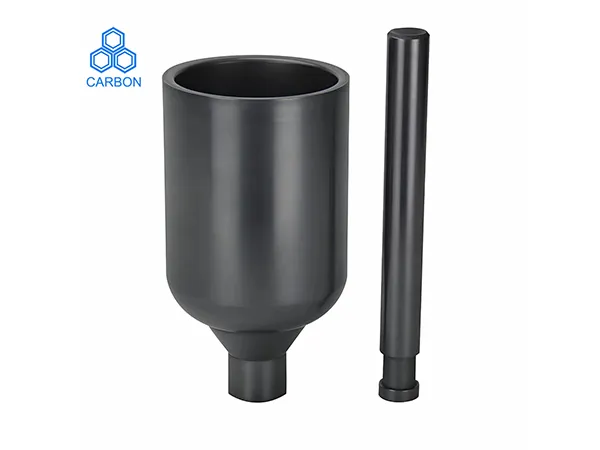
Not all thermal shock resistant crucibles are equal. The key differentiators lie in raw material quality, pressing technique, and firing consistency. Cangzhou Carbon controls the entire production process, from selecting premium flake graphite and high-purity silicon carbide to isostatic pressing for uniform density. Every batch undergoes thermal shock testing to ensure it meets strict standards before shipment. This commitment to quality means you get a crucible that performs reliably under real-world conditions.
Additionally, Cangzhou Carbon offers technical support to help you select the right crucible grade for your specific furnace type, alloy, and operating cycle. This customized approach maximizes the cost-saving potential of thermal shock resistance.
Stopping cracks is not just about preventing an inconvenience — it is a strategic cost reduction measure. By switching to thermal shock resistant crucibles from Cangzhou Carbon, you cut downtime, reduce consumption of new crucibles, improve energy efficiency, and maintain higher product quality. The upfront investment is quickly recouped through lower total ownership costs. In competitive foundry operations, the choice is clear: invest in crucibles that can handle the real demands of rapid thermal cycling.
