E-Mail:kb@czgraphite.com
Tel:+86 15533739372

Graphite news is mainly for industry users to share graphite materials and products and other related technical information, so that customers can keep abreast of industry trends and developments.
Time: 2026-06-22 02:36:01 Source: Cangzhou Carbon Technology Co., Ltd.
Selecting the right crucible for high-temperature metal melting or alloy production at 1600°C is a critical decision that directly impacts process efficiency, product quality, and operational cost. While both graphite and clay crucibles are widely used, their performance diverges significantly under extreme thermal loads. This article provides a rigorous technical comparison, equipping engineers and procurement professionals with the data needed to choose the optimal material for applications requiring sustained 1600°C performance.
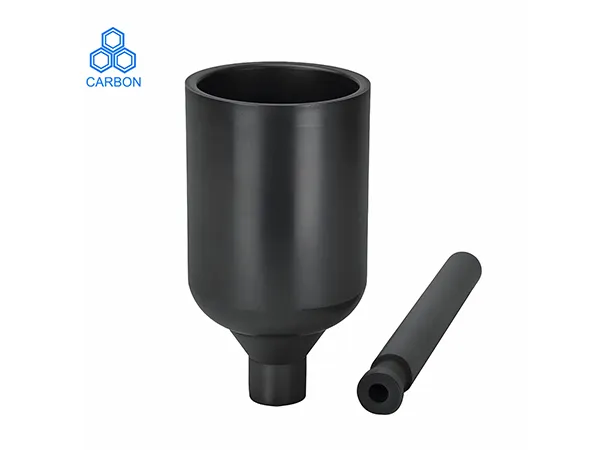
Graphite crucibles are manufactured from high-purity natural or synthetic graphite, often bonded with carbonaceous binders and fired at ultra-high temperatures. The resulting structure is highly crystalline, giving graphite exceptional thermal conductivity (typically 100–130 W/m·K) and low thermal expansion. These properties make graphite crucibles extremely resistant to thermal shock—a critical advantage when rapidly heating to 1600°C or cooling.
Clay crucibles, also known as ceramic or refractory crucibles, are made from aluminosilicate clays (such as fireclay) blended with grog (fired clay particles) to reduce shrinkage. Their microstructure is more amorphous and porous than graphite. Thermal conductivity is low (around 1–3 W/m·K), meaning clay crucibles heat more slowly but provide better insulation. However, their coefficient of thermal expansion is higher, making them more prone to cracking under rapid temperature changes.
When operated continuously at 1600°C, the following factors determine crucible suitability.
High-thermal-shock scenarios (e.g., rapid melting cycles, induction heating) demand graphite. Its high conductivity allows energy-efficient heating and uniform temperature distribution. For casting precious metals, superalloys, or aluminum-lithium alloys that require minimal contamination, graphite is preferred. Cangzhou Carbon’s high-density graphite crucibles offer oxidation resistance through surface treatments, extending air-atmosphere life.
Clay crucibles remain advantageous for long-batch processes with gradual heating and cooling. Their lower cost per unit is attractive for low-melting-point metals like lead or zinc. Additionally, certain glass melting and brazing operations favor the non-wetting properties of clay. However, at 1600°C, the user must select only high-alumina or silicon carbide-reinforced clay grades, which approach graphite cost but lack thermal-shock resistance.
Initial purchase price often favors clay crucibles ($5–$15 per unit for small sizes) versus graphite ($20–$80). However, when factoring in replacement frequency, downtime, energy consumption, and scrap rates, graphite crucibles typically deliver lower total cost of ownership above 1500°C. A case study in brass melting showed that switching from clay to Cangzhou Carbon graphite crucibles reduced replacement frequency by 80% and cut energy use by 22% due to faster heating.
Yes, if they are high-alumina (>60% Al₂O₃) or fused silica formulations. Standard fireclay crucibles fail above 1400°C. Check the datasheet for maximum service temperature.
Bare graphite loses about 0.1–0.3 mm/month at 1600°C in air due to oxidation. Protective coatings (silicon carbide, zirconium) extend life significantly. Cangzhou Carbon offers coated versions for air-environment use.
For continuous operation above 1500°C, graphite is more economical despite higher upfront cost. For intermittent low-stress applications, clay can be cost-effective.
The choice between graphite and clay crucible at 1600°C hinges on thermal cycle requirements, chemical environment, and lifecycle economics. Graphite crucibles dominate in terms of thermal shock resistance, temperature capability, and longevity, making them the standard for demanding high-temperature processes. Clay crucibles retain niche advantages where cost per batch and slow heating are acceptable. For engineers seeking reliable performance at 1600°C, investing in quality graphite crucibles from experienced manufacturers like Cangzhou Carbon ensures process stability and reduced operational risk.
