E-Mail:kb@czgraphite.com
Tel:+86 15533739372


Graphite news is mainly for industry users to share graphite materials and products and other related technical information, so that customers can keep abreast of industry trends and developments.
Time: 2025-12-27 08:09:51 Source: Cangzhou Carbon Technology Co., Ltd.
In modern steel casting and metal industry, graphite molds have always played an important role and are widely used due to their excellent thermal conductivity, low coefficient of thermal expansion, and high temperature resistance. The reason graphite molds are the preferred choice for their thermal conductivity is that these properties can be translated into advantages. But why is thermal conductivity so important? How does it influence steel casting production processes? Let's delve into the underlying principles.
Thermal conductivity refers to a material’s ability to conduct heat. In steel casting, this property is critical because it dictates how quickly heat is transferred from the molten steel to the mold and subsequently dissipated. Graphite, being a carbon-based material, exhibits high thermal conductivity—typically ranging from 80 to 200 W/m·K, depending on its density and grain orientation. This allows for rapid and uniform heat transfer during the solidification of steel.
Faster Cooling Rates: Efficient heat transfer promotes quicker solidification of the steel, reducing cycle times in continuous casting and improving production efficiency.
Uniform Temperature Distribution: Consistent cooling minimizes internal stresses and prevents defects such as cracks, porosity, or uneven microstructure in the cast billets.
Improved Surface Finish: Rapid and uniform heat dissipation can enhance the surface quality of steel billets, reducing the need for post-casting processing.
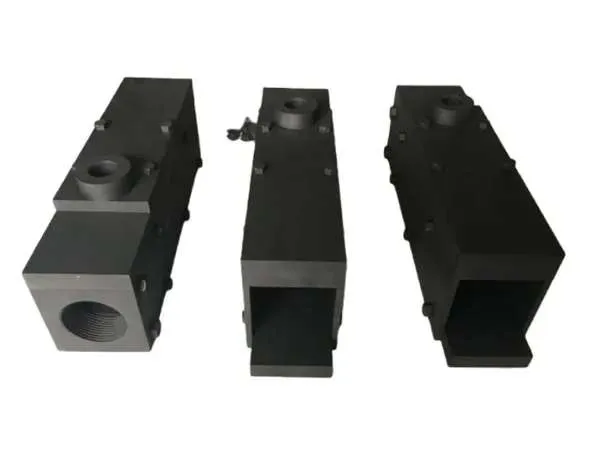
The solidification process of steel is highly sensitive to temperature gradients. If the mold does not conduct heat efficiently, certain areas of the steel billet may cool too slowly, causing microstructural inconsistencies and mechanical weaknesses. Graphite molds, with their excellent thermal properties, help maintain a controlled cooling profile, ensuring that the steel develops uniform grain structures and desired mechanical properties.
Additionally, the anisotropic thermal behavior of graphite—meaning its thermal conductivity differs along different crystal orientations—can be leveraged in mold design. By aligning the graphite grains strategically, manufacturers can optimize heat flow to critical areas of the mold, achieving more consistent casting results and reducing material wastage.
While thermal performance is a major factor, graphite molds also offer:
Chemical Inertness: Resistance to molten steel reactions prevents contamination and prolongs mold life.
Mechanical Stability: High strength and resistance to thermal shock ensure that molds maintain shape under repeated heating and cooling cycles.
Ease of Machining: Graphite can be precisely shaped to complex geometries, allowing for custom mold designs that meet specific casting requirements.
To fully leverage the thermal advantages of graphite molds in steel casting, consider the following:
Regular Inspection: Check for wear and thermal cracks to maintain uniform heat transfer.
Controlled Preheating: Gradually heat molds to reduce thermal stress and prevent sudden temperature shocks.
Proper Lubrication or Coating: Some casting operations benefit from protective coatings to further enhance heat transfer and reduce sticking of steel to the mold surface.
Design for Heat Flow: Work with mold suppliers to align graphite grain orientation and mold thickness to optimize thermal conduction paths.
The thermal conductivity of graphite molds is crucial in modern steel casting. Graphite molds ensure rapid and uniform cooling, improve billet quality, and increase production efficiency. Due to their superior thermal conductivity, they bring significant benefits to the steel casting industry and the metal industry. Therefore, a thorough understanding and utilization of graphite's thermal properties is essential for high-performance steel casting.

 Russian