E-Mail:kb@czgraphite.com
Tel:+86 15533739372


Graphite news is mainly for industry users to share graphite materials and products and other related technical information, so that customers can keep abreast of industry trends and developments.
Time: 2026-09-21 02:36:06 Source: Cangzhou Carbon Technology Co., Ltd.
In the world of high-temperature metallurgy, vacuum melting presents unique challenges that demand specialized tooling. Among these, the graphite crucible stands as a critical component, directly influencing melt quality, process efficiency, and operational safety. Engineers and procurement specialists seeking a graphite crucible for vacuum melting must evaluate purity, thermal stability, mechanical strength, and service life. This article examines the key features that define a reliable crucible for vacuum environments, with a focus on how Cangzhou Carbon delivers solutions tailored to these stringent requirements.
Vacuum melting is used for producing high-purity alloys, superalloys, and reactive metals such as titanium and zirconium. The crucible must withstand extreme temperatures (up to 2000°C or higher), rapid thermal cycling, and aggressive chemical interactions with molten metals. Unlike conventional melting in air, vacuum conditions eliminate oxidation but introduce risks of outgassing, contamination from crucible materials, and structural failure. Therefore, a graphite crucible for vacuum melting must possess specific properties that go beyond those of standard graphite crucibles.
A crucible used in vacuum must have minimal open porosity. Open pores can trap gases and moisture, which are released under vacuum and high temperature, causing contamination or bubbling in the melt. High-density graphite (typically >1.85 g/cm³) reduces gas permeability and improves mechanical strength. Cangzhou Carbon manufactures crucibles using isostatic pressing and fine-grain graphite to achieve density above 1.90 g/cm³, ensuring excellent vacuum-tightness.
Vacuum melting often involves rapid heating and cooling cycles. The crucible must resist cracking caused by thermal gradients. Fine-grain graphite with optimized binder systems provides higher thermal conductivity and lower coefficient of thermal expansion, enabling the crucible to endure repeated quenching. Our crucibles are engineered with a thermal shock resistance index that exceeds industry norms, reducing downtime and replacement costs.
Any impurities in the crucible—such as sulfur, boron, or metallic elements—can leach into the molten metal and alter its properties. For vacuum melting, crucibles require ultra-high purity (ash content <50 ppm, often <20 ppm). Cangzhou Carbon utilizes high-purity raw materials and a dedicated purification process (graphitization at >2400°C) to minimize ash and volatile residues. This ensures that the crucible does not become a source of contamination even in sensitive applications like semiconductor grade silicon or superalloys.
During vacuum melting, the crucible experiences not only thermal stress but also chemical attack from molten metals and slags. The graphite material must resist erosion and wetting by aggressive melts. Key features include:
Our crucibles are designed with a uniform fine-grain microstructure that minimizes anisotropic effects, providing consistent mechanical performance in all directions.
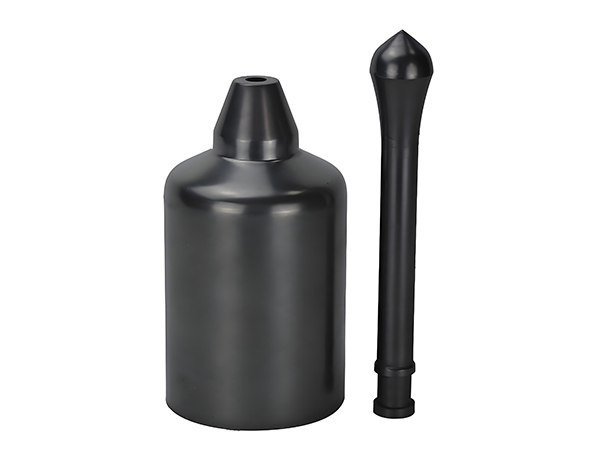
No single crucible geometry fits all vacuum melting furnaces. Induction furnaces require crucibles with specific wall thickness and electrical conductivity. Resistance-heated furnaces may need different shapes. Cangzhou Carbon offers custom-machined graphite crucibles with tight tolerances to match your furnace coil design, including pouring spouts, handles, and tapered walls for easy ingot release.
With over a decade of specialized manufacturing, Cangzhou Carbon has developed a comprehensive quality control system that addresses the unique demands of vacuum melting. We select only needle coke and coal tar pitch with controlled impurity levels. Our isostatic pressing technology ensures uniform density. After machining, each crucible undergoes a rigorous vacuum outgassing test to verify that it meets the required leak rate. For applications requiring extreme purity, we offer additional halogen purification to reduce boron content to below 0.5 ppm.
Beyond material properties, we provide technical support to help customers choose the right graphite grade and crucible design. Our engineers can advise on wall thickness optimization to balance capacity and thermal performance, as well as coating options (such as silicon carbide or boron nitride) for extended service life when handling very aggressive melts.
A well‑designed graphite crucible for vacuum melting can last for dozens or even hundreds of cycles. The total cost of ownership depends on initial price, lifespan, and crucible-related defects. Cangzhou Carbon's crucibles are known for consistent quality that reduces premature failure. Many customers report 30% longer service life compared to generic alternatives, while maintaining melt purity.
Q: Can I use a standard graphite crucible for vacuum melting?
A: No. Standard crucibles often have higher porosity and impurity levels, leading to vacuum leaks and contamination. Always choose crucibles specifically designed for vacuum service.
Q: How do I know if a crucible has adequate purity?
A: Request an ash content analysis and a certificate from the manufacturer. For vacuum melting, aim for ash content less than 50 ppm. Cangzhou Carbon provides detailed material data sheets upon request.
Q: What is the typical lead time for custom crucibles?
A: Depends on size and complexity. Standard shapes are often available within 2 weeks; custom designs may take 4–6 weeks. Contact our sales team for current lead times.
Selecting the right graphite crucible for vacuum melting is a decision that directly impacts product quality, process reliability, and operating costs. High density, thermal shock resistance, ultra‑high purity, and tailored design are the key features to evaluate. Cangzhou Carbon combines premium materials, advanced manufacturing, and rigorous testing to deliver crucibles that meet the exacting standards of vacuum metallurgy. When your application demands performance without compromise, trust a crucible built specifically for the vacuum environment.
