E-Mail:kb@czgraphite.com
Tel:+86 15533739372


Graphite news is mainly for industry users to share graphite materials and products and other related technical information, so that customers can keep abreast of industry trends and developments.
Time: 2026-09-07 02:36:32 Source: Cangzhou Carbon Technology Co., Ltd.
For foundries and smelting operations working with non-ferrous metals such as aluminum, copper, zinc, and their alloys, the choice of crucible directly impacts melt quality, energy consumption, and overall productivity. While standard crucibles serve general purposes, the demanding conditions of non-ferrous metal casting often require customized solutions. Custom graphite crucibles are engineered to match specific furnace geometries, temperature profiles, and alloy chemistries, delivering longer service life and consistent performance. Cangzhou Carbon, a trusted manufacturer in the crucible industry, specializes in designing and producing custom graphite crucibles that meet the exact needs of each casting operation, ensuring maximum efficiency and cost-effectiveness.
Non-ferrous metals present unique challenges during melting and holding. Aluminum alloys can be highly aggressive to refractory materials, while copper and brass require high operating temperatures that accelerate thermal fatigue. Off-the-shelf crucibles may not provide the best fit for these variables, leading to premature failure or suboptimal heat transfer. Customization allows you to optimize three critical aspects: dimensions, material composition, and wall thickness.
Crucibles must fit precisely within induction furnaces, gas-fired furnaces, or resistance furnaces to maintain proper metal flow and heat distribution. Cangzhou Carbon works with clients to define exact outer and inner diameters, height, and lip design, ensuring seamless integration. A poorly fitting crucible can cause uneven heating, increase energy waste, and create safety hazards from metal spillage.
Different non-ferrous metals require different levels of oxidation resistance and chemical stability. Custom formulations can adjust the ratio of graphite, silicon carbide, clay, and other additives. For example, crucibles used for melting zinc or aluminum need excellent resistance to molten metal attack, while those for copper require higher thermal conductivity and strength at temperatures above 1100°C. Cangzhou Carbon uses proprietary recipes to tailor these properties without compromising cost.
A custom crucible may have a higher upfront price, but its extended lifespan and reduced downtime quickly offset the initial investment. By matching the crucible’s thermal expansion characteristics to your furnace’s heating cycle, you minimize cracking and deformation. This results in fewer crucible changes, lower refractory costs, and more consistent production schedules.
When evaluating custom crucible options, focus on these critical performance metrics that directly affect your casting operation:
Cangzhou Carbon tests each custom batch against these KPIs, providing certification documentation upon request. This rigor ensures your crucible will perform reliably under actual production conditions.
The base material of a graphite crucible largely determines its suitability for different non-ferrous metals. Three common types are available, and the choice depends on your specific alloy and operating parameters.
These traditional crucibles use natural graphite flakes bonded with refractory clay. They offer good thermal shock resistance and are economical, making them ideal for low-to-medium temperature applications such as melting aluminum (below 800°C). However, they have lower mechanical strength and oxidation resistance at higher temperatures.
By incorporating silicon carbide (SiC) particles into the graphite matrix, these crucibles achieve superior thermal conductivity (up to 40% higher than clay-bonded) and exceptional wear resistance. They are well-suited for copper, bronze, and brass melting where temperatures exceed 1000°C. The added SiC also improves resistance to slag attack.
Manufactured using uniform high-pressure isostatic pressing, these crucibles have a fine, dense structure with no directional weakness. They provide excellent thermal shock resistance and can handle extreme temperature cycles. Isostatic crucibles are preferred for high-purity alloys and vacuum casting applications. Although more expensive, they offer the longest service life.
Cangzhou Carbon provides all three types in custom configurations. Our engineers help you select the optimal material based on your melt temperature, alloy composition, and budget.
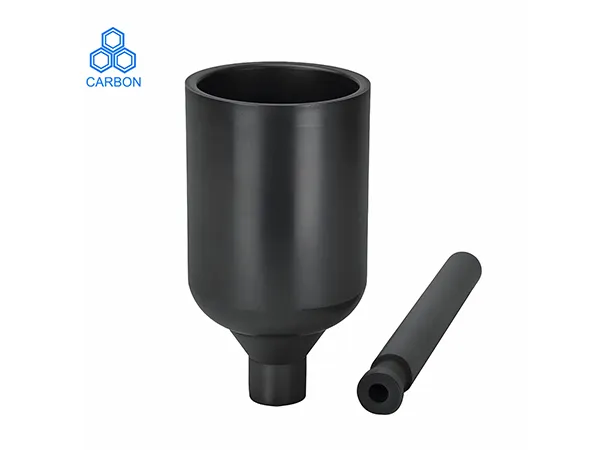
Ordering a custom graphite crucible from Cangzhou Carbon follows a structured workflow that ensures your requirements are translated into a finished product with precision.
Step 1 – Requirement Analysis: We gather details about your furnace type, typical melting temperature, alloy chemistry, cycle frequency, and any specific installation constraints. This data forms the basis for material selection and dimensional design.
Step 2 – Material Formulation: Our R&D team adjusts the recipe (graphite grade, SiC percentage, bonding clay, and additives) to achieve target performance. A small trial batch may be produced for testing if needed.
Step 3 – Mold Design & Fabrication: Using CAD software, we design the crucible geometry with proper draft angles, wall thickness, and lip contours. Molds are machined from high-grade steel to ensure repeatability over large production runs.
Step 4 – Forming: Depending on the material type, we use either ramming, vibration casting, or isostatic pressing to shape the crucible. Each method is controlled for density uniformity.
Step 5 – Firing & Quality Control: Crucibles are fired in controlled atmosphere kilns to achieve full sintering. Each unit undergoes dimensional inspection, visual check, and optional density/porosity testing. We can also perform thermal shock tests on sample pieces.
Step 6 – Packaging & Delivery: Custom crucibles are individually packed with shock-absorbing materials and shipped globally. Typical lead time for custom orders is 4–6 weeks, but express options are available for urgent needs.
With a decade of expertise in manufacturing graphite and carbon products, Cangzhou Carbon has become a reliable partner for non-ferrous metal foundries worldwide. Our advantages include:
By choosing Cangzhou Carbon, you gain a partner who understands that a crucible is not just a container – it is a key component that influences melt quality, energy efficiency, and production uptime.
Custom graphite crucibles are an investment in operational excellence for non-ferrous metal casting. Whether you need a clay-bonded crucible for aluminum, a SiC crucible for copper alloys, or a high-performance isostatic pressed crucible for critical applications, Cangzhou Carbon delivers solutions that are precisely engineered to your specifications. Contact us today to discuss your crucible requirements and discover how a custom approach can improve your foundry's bottom line.

 Russian